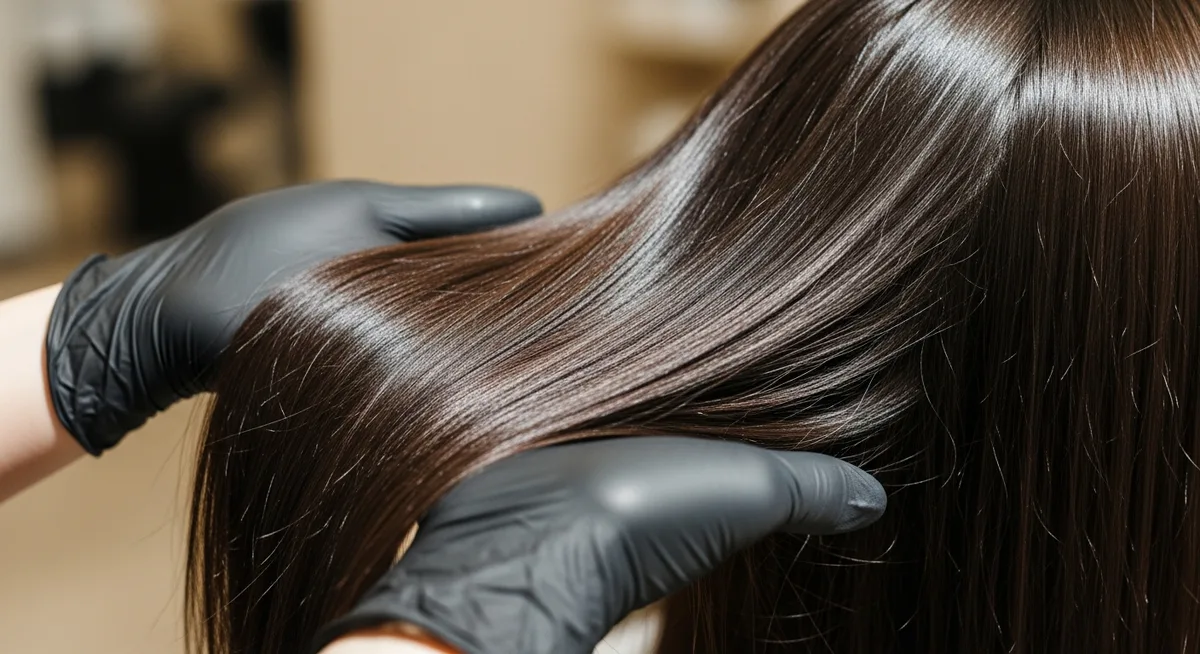
If you work behind the chair, you have almost certainly been asked: "Can you give me colour without the commitment?" The answer is demi-permanent hair colour, and it is quickly becoming one of the most requested services in professional salons worldwide. But what exactly is demi-permanent colour, how does it differ from permanent and semi-permanent formulas, and why are so many stylists making it a core part of their colour menu?
Demi-Permanent Colour Explained
Demi-permanent hair colour sits between semi-permanent and permanent colour on the spectrum of longevity and chemical action. It uses a low-volume developer, typically between 2 and 10 volume, to deposit colour pigment into the outer cortex of the hair shaft without fully opening the cuticle the way permanent colour does. Because it does not contain ammonia or high-alkalinity agents, the colour molecules penetrate gently rather than forcing the cuticle open.
The result is colour that lasts significantly longer than a semi-permanent rinse, typically 20 to 28 shampoos, yet fades gradually and naturally without a hard line of regrowth. This makes demi-permanent colour ideal for clients who want enriched tone, enhanced shine, and soft grey coverage without the maintenance cycle that permanent colour demands.
How It Differs from Permanent Colour
Permanent hair colour uses ammonia or an alkaline substitute to raise the cuticle and allow large colour molecules to enter the cortex, where they undergo an oxidation reaction and become trapped inside the hair. This produces long-lasting results that can lighten the natural pigment by several levels, but it also creates a visible regrowth line and subjects the hair to more structural change.
Demi-permanent colour, by contrast, cannot lift natural pigment. It deposits tone only, which means it works with the hair's existing level rather than against it. This is precisely why it excels at services like toning, gloss treatments, grey blending, colour refreshing, and adding richness to natural or previously coloured hair.
Key Differences at a Glance
- Ammonia: Permanent colour contains ammonia; demi-permanent does not
- Lifting power: Permanent can lighten hair; demi-permanent deposits only
- Developer: Permanent uses 20-40 volume; demi-permanent uses 2-10 volume
- Longevity: Permanent lasts until it grows out; demi-permanent fades over 20-28 washes
- Regrowth: Permanent creates a visible root line; demi-permanent fades without a hard demarcation
- Hair condition: Demi-permanent leaves hair in noticeably better condition due to its gentle pH
How It Differs from Semi-Permanent Colour
Semi-permanent colour uses no developer at all. It coats the outer surface of the hair with colour pigment that washes away after 6 to 12 shampoos. While semi-permanent formulas are extremely gentle, they offer limited longevity and virtually no grey coverage.
Demi-permanent colour lasts roughly twice as long because the low-volume developer allows pigment to penetrate slightly deeper into the hair structure. This gives it the ability to blend grey hair with a natural, translucent effect rather than the opaque coverage that permanent colour provides. For clients who are grey-curious or grey-resistant, this softer approach is often exactly what they want.
The Benefits of Demi-Permanent Colour for Salons
Versatility on the Colour Menu
Demi-permanent colour is one of the most versatile tools in a colourist's kit. It handles toning after lightening services, refreshes faded ends during a root touch-up appointment, adds depth and dimension as a standalone gloss, corrects unwanted tones, and provides beautiful grey blending. A single system can serve dozens of use cases, which simplifies inventory and training.
Client Comfort and Satisfaction
Because demi-permanent formulas operate at a neutral or near-neutral pH and contain no ammonia, the application experience is dramatically more comfortable for clients. There is no strong chemical odour, no scalp irritation, and the hair feels soft and conditioned immediately after rinsing. For salons focused on the client experience, this matters enormously.
Low Maintenance, High Return Visits
The gradual fade pattern of demi-permanent colour is a powerful retention tool. Clients return every four to six weeks not because they "have to" but because they want to refresh their gloss. This creates a predictable rebooking rhythm and builds long-term loyalty without the pressure of visible regrowth.
Hair Health and Integrity
Demi-permanent colour is inherently less damaging than permanent colour because it does not alter the internal structure of the hair. For clients with fine, fragile, or previously over-processed hair, it provides colour results without further compromise. Many formulas, including ammonia-free and PPD-free systems like KEYLUMA PICTO, go further by incorporating conditioning agents that improve the hair's feel and appearance with every application.
Who Is Demi-Permanent Colour For?
Almost any client can benefit from demi-permanent colour, but it is especially well suited for:
- Clients new to colour who want to ease in without full commitment
- Anyone seeking natural-looking grey blending rather than total grey coverage
- Clients wanting a glossy, tonal refresh between permanent colour appointments
- Those with sensitive scalps or allergies to ammonia and PPD
- Clients with fine or damaged hair who need colour without additional stress on the hair
- Men's grooming clients seeking subtle, undetectable colour enhancement
How Long Does Demi-Permanent Colour Last?
Most professional demi-permanent colour systems last between 20 and 28 shampoos, which translates to roughly four to six weeks for the average client. The exact duration depends on hair porosity, shampoo frequency, water temperature, and the specific formula used. Highly porous or damaged hair may absorb and release colour more quickly, while healthy, virgin hair tends to hold demi-permanent pigment longer.
Unlike permanent colour, demi-permanent fades tone-on-tone, meaning the hair returns gracefully to its previous state rather than revealing a stark contrast at the root. This natural fade is one of the key reasons clients and stylists alike prefer it for gloss and toning services.
Demi-permanent hair colour represents a shift in how salons think about colour services. It is no longer a compromise or a secondary option but a primary tool that delivers beautiful results with less damage, greater comfort, and a maintenance pattern that keeps clients coming back. For salon professionals looking to offer a modern, gentle, and versatile colour system, KEYLUMA PICTO provides exactly that: 30 shades of demi-permanent colour crafted in Italy, entirely ammonia-free and PPD-free, with a neutral pH that respects both the hair and the client.
Back to Blog