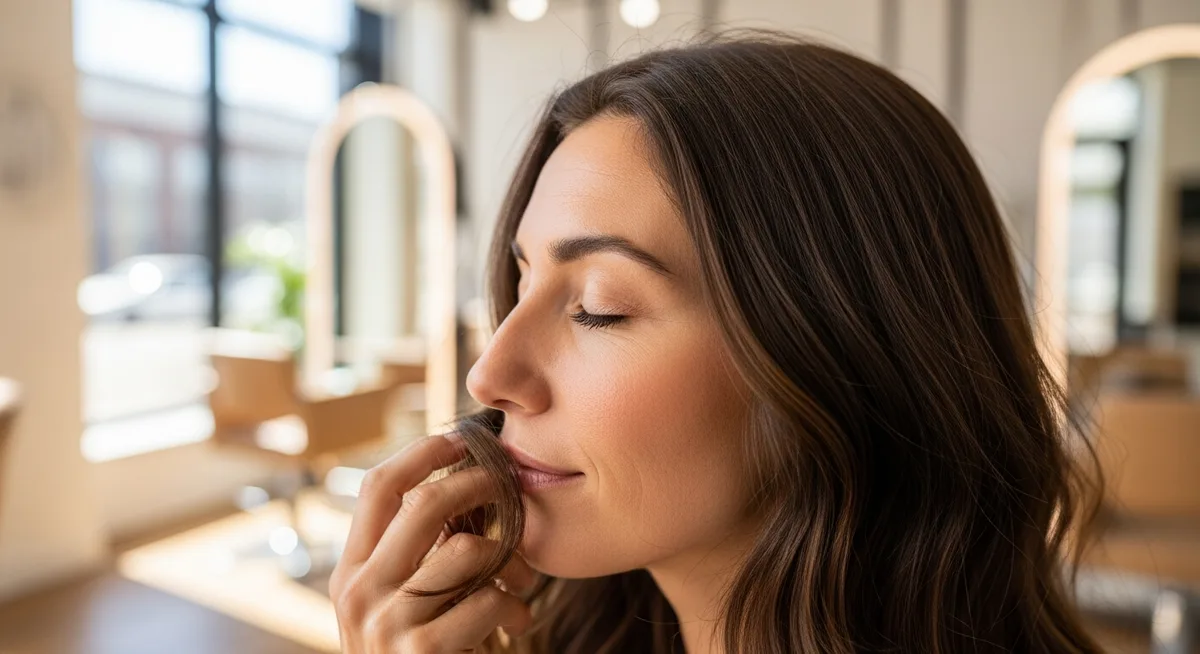
For decades, ammonia was considered essential to professional hair colour. It was the ingredient that made everything work: swelling the hair shaft, raising the cuticle, and allowing permanent pigment to penetrate deep into the cortex. But that power came at a cost. The sharp chemical smell, the burning sensation on sensitive scalps, the gradual drying of hair with repeated applications. Today, a growing number of salon professionals are moving to ammonia-free hair colour, and the reasons go far beyond comfort.
What Does Ammonia Do in Hair Colour?
Ammonia is an alkaline gas dissolved in water. In hair colour formulations, it serves two primary purposes. First, it raises the pH of the mixture, which causes the hair cuticle to swell and open. This allows colour molecules and the developer to enter the cortex. Second, it helps activate the oxidation process that forms permanent colour molecules inside the hair.
The problem is that ammonia is aggressive. It raises the pH of colour formulas to around 9.5 to 10.5, well above the hair's natural pH of 4.5 to 5.5. This dramatic shift weakens the protein bonds within the hair, strips away protective lipids, and leaves the cuticle roughened. Over time, this leads to dryness, brittleness, and loss of elasticity, especially with frequent colouring.
How Ammonia-Free Colour Works
Ammonia-free hair colour systems use alternative alkalising agents, most commonly monoethanolamine (MEA), or operate at a neutral pH close to the hair's natural level. In demi-permanent formulas like KEYLUMA PICTO, the approach is fundamentally different: instead of forcing the cuticle wide open, the formula works with a low-volume developer to gently deposit colour into the outer cortex without aggressive chemical action.
The result is colour that is deposited without the structural damage that ammonia-based formulas inflict. The cuticle remains smoother, moisture is retained, and the hair feels noticeably better after processing than before.
What Is PPD and Why Does It Matter?
Para-phenylenediamine (PPD) is a chemical compound found in the vast majority of permanent hair colour formulas. It is responsible for producing the deep, rich, long-lasting colour tones that clients expect from permanent services. However, PPD is also one of the most common causes of allergic contact dermatitis in hair colour.
Reactions to PPD can range from mild scalp irritation and redness to severe swelling, blistering, and in rare cases, anaphylaxis. The European Commission's Scientific Committee on Consumer Safety has identified PPD as a strong sensitiser, meaning that once a person develops an allergy to it, they will react to it every subsequent time they are exposed.
For salon professionals, this means a growing segment of clients who either cannot use traditional permanent colour or are actively seeking PPD-free alternatives. PPD-free formulations eliminate this risk entirely, allowing colourists to serve sensitive clients confidently and safely.
The Health Benefits for Clients
Reduced Scalp Sensitivity
Ammonia-free formulas operate at a gentler pH, which dramatically reduces the burning, tingling, and itching sensations that many clients experience during colour services. For clients who have previously reported discomfort with permanent colour, switching to an ammonia-free system can be the difference between tolerating a service and genuinely enjoying it.
Better Hair Condition Over Time
Hair that is repeatedly coloured with high-pH, ammonia-based formulas gradually loses its structural integrity. The cuticle becomes progressively more damaged, leading to frizz, porosity issues, and dullness. Ammonia-free colour preserves the cuticle layer, maintaining the hair's natural moisture balance and producing results that actually improve with repeated applications rather than degrading.
Safer for Pregnant and Sensitive Clients
While no hair colour is formally approved for use during pregnancy, ammonia-free and PPD-free formulas represent a significantly gentler option for clients who wish to continue colour services during this period. The absence of harsh fumes and known sensitisers provides reassurance for both the client and the stylist.
The Benefits for Salon Professionals
Cleaner Salon Air Quality
Ammonia is a volatile gas. Every time a colourist mixes and applies an ammonia-based colour, ammonia vapour is released into the salon air. For professionals who mix colour dozens of times a day, this represents a significant occupational exposure. Chronic inhalation of ammonia vapour can irritate the respiratory tract, trigger headaches, and contribute to occupational asthma over time.
Ammonia-free colour eliminates this exposure entirely. The salon smells better, the air is healthier, and stylists report fewer end-of-day headaches and less respiratory irritation. For salon owners investing in staff well-being, this is a tangible improvement.
Expanded Client Base
By offering an ammonia-free, PPD-free colour system, salons can serve clients who would otherwise be unable to receive colour services. This includes clients with known allergies, those with sensitive skin conditions such as eczema or psoriasis, and anyone who has had a negative reaction to colour in the past. Rather than turning these clients away, the salon can provide a safe and luxurious alternative.
Premium Positioning
Clients are increasingly educated about ingredients and health. Offering a gentle, ammonia-free, PPD-free colour system positions the salon as forward-thinking and client-centred. It is a genuine point of differentiation that supports premium pricing and builds trust with health-conscious consumers.
Does Ammonia-Free Colour Perform as Well?
This is the question every professional asks. The honest answer is that ammonia-free colour performs differently rather than lesser. It cannot lighten natural hair the way ammonia-based permanent colour can, and it is not designed to. But for the vast majority of colour services, including toning, gloss treatments, grey blending, colour refreshing, and deposit-only applications, ammonia-free demi-permanent colour delivers equal or superior results with dramatically better hair condition.
Modern ammonia-free formulations have closed the performance gap significantly. Systems like KEYLUMA PICTO offer rich, true-to-swatch colour payoff, predictable processing, and excellent grey blending, all without ammonia, PPD, or aggressive pH levels.
The shift to ammonia-free hair colour is not a trend. It is a permanent evolution in how professional colour is formulated, applied, and experienced. For salon professionals who want to protect their health, serve a wider client base, and deliver results that leave hair in genuinely better condition, ammonia-free colour is no longer optional. Explore the KEYLUMA PICTO system to see what gentle professional colour looks like.
Back to Blog